
Zwinger: how long is the free audio guide?
About 6 minutes of listening in 5 sections: “Welcome to Zwingergarten”, “A Garden Between Two Walls”, “Orange Trees and Festivals”, “From Ruin to Museum Quarter”, and “Before You Head Off”.
The garden name behind Dresden's Baroque Zwinger

Quick answer. Yes. Mappu’s Zwinger audio guide (Dresden, Germany) is free in your browser: 5 sections and about 6 minutes of listening, in 6 languages. It covers “A Garden Between Two Walls”, “Orange Trees and Festivals” and “From Ruin to Museum Quarter”. In the Mappu app, Walk Mode narrates the places around you as you move and answers your follow-up questions.
Welcome to the Zwingergarten, set within the Zwinger, one of the great Baroque landmarks of Dresden. You are on the northwestern edge of the Innere Altstadt, the inner old town, with Dresden Castle and the Semperoper close by. A word on the name before we begin. The story of the Zwingergarten belongs to the whole Zwinger complex, and the name is older than the palace you see today. The royal garden that first bore it sat somewhere between the city's western fortifications, and its precise position is only imprecisely known. So in this guide I will tell you about the Zwinger and the garden tradition around you, and I will say clearly when I am speaking about the wider complex rather than one exact patch of lawn. The name comes from the word Zwinger, which describes a narrow strip between an outer and an inner defensive wall. Remarkably, that medieval-sounding word ended up attached to one of the most graceful festival palaces in Germany. Let's find out how.
Picture Dresden's western edge before the Baroque palace existed. The area between the outer and inner walls was generally called the Zwinger, and near the castle the royal court used that ground for garden purposes. This royal Zwingergarten was a garden that supplied the court, and it still did its original job as a narrow defensive strip between the two walls. One account traces the garden back to the time of Elector Moritz, who lived from 1521 to 1553. It says that from 1549 he laid out a garden modelled on the castle garden in Prague, and that this garden was also called the Zwingergarten. The wall itself has left a trace. The southwestern parts of the Baroque Zwinger, including the Kronentor gate, stand on sections of the outer curtain wall that are still visible today. Of the inner wall, nothing remains. So when you look at this elegant complex, you are looking at a palace built on the footprint of an old fortified garden strip.
The Baroque story begins in 1709. Augustus the Strong was looking for a winter home for his large collection of little orange trees and other potted plants. He commissioned his chief master builder, Matthäus Daniel Pöppelmann, to build an orangery in the Zwingergarten. The plan grew quickly. A hand sketch from that year already shows a four-tiered, semicircular terrace for the site. Later the complex was also meant for court festivities. Baroque festival culture was not only entertainment. It was a way for a ruler to show wealth and sovereign power, and the Zwinger became a stage for exactly that. Augustus's passion for oranges did not end here. A few years later he also had an orangery built in the Baroque garden of Großsedlitz, southeast of Dresden, which housed no fewer than 1250 orange trees. The architect and the sculptor are the two names you will hear again and again here: Pöppelmann, the architect, and Balthasar Permoser, the sculptor, who came from the Chiemgau region of Bavaria and arrived in Dresden as court sculptor in 1689.
The Zwinger has always been reworked. It has been restored several times, partly because of destruction or decay and partly because ideas about preserving monuments changed. In the nineteenth century a new wing was added, designed by Gottfried Semper. Originally planned as a separate museum, it came to be known as the Semperbau, and it is decorated with carvings by the Dresden sculptor Ernst Rietschel. The Sempergalerie opened in 1855 and became the home of the Gemäldegalerie Alter Meister, the Old Masters Picture Gallery. It was one of the most important German museum projects of the century, and it made the Zwinger a museum complex. Then came the bombing of Dresden on February 13 and 14, 1945, which left the Zwinger almost completely destroyed. Reconstruction began in 1945, and parts were able to reopen as early as 1960. Today the complex houses parts of the Staatliche Kunstsammlungen Dresden, the Dresden State Art Collections, and it is widely considered one of the finest examples of Baroque architecture.
Take another slow look around. This place began as a defensive strip between two walls, became a court garden, then a Baroque orangery and festival ground. Later it became a museum quarter, and in the twentieth century it rose again from near-total destruction. A nineteenth-century wood engraving even shows the Zwinger as a playground for the people of Dresden. That is a nice reminder that a place built for kings has long been shared with everyone. As you wander, notice the sculpture, the line of the old outer wall near the Kronentor, and the way Dresden Castle and the Semperoper sit just beyond. Each one adds a chapter to a story that is still being told.
AI-generated from 6 sources; checked automatically and last updated on October 23, 2026. Verify tickets and opening hours on the official site.
Tickets, tours and practical extras for this trip, from Mappu's partners.
Partner links (Airalo, Amazon, Booking.com, GetYourGuide, Klook, Tiqets, Trip.com, Viator, Welcome Pickups): if you book or buy through them, Mappu may earn a commission, at no extra cost to you.
 Frauenkirche DresdenDresden
 Prague Castle at HradcanyPrague
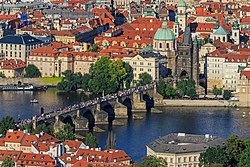 Charles BridgePrague
 Prague Old Town WalkPrague
 Emmaus MonasteryPrague
 Sanssouci PalacePotsdam
Plan your trip on a map and get an audio guide for almost any place nearby: just tap it on the Mappu map.
About 6 minutes of listening in 5 sections: “Welcome to Zwingergarten”, “A Garden Between Two Walls”, “Orange Trees and Festivals”, “From Ruin to Museum Quarter”, and “Before You Head Off”.
You can ask follow-up questions such as “How did the word Zwinger, a narrow defensive strip between two walls, end up naming a Baroque palace?” and keep asking in Mappu, with the guide connected to your map and trip plan.