


Charles Bridge: how long is the free audio guide?
About 6 minutes of listening in 5 sections: “Welcome to Charles Bridge”, “A Crossing Born from a Flood”, “The Avenue of Saints”, “Survivor of Floods, Cannons and Crowds”, and “Before You Head Off”.
Audio guide for Charles Bridge

Quick answer. Yes. Mappu’s Charles Bridge audio guide (Prague, Czechia) is free in your browser: 5 sections and about 6 minutes of listening, in 6 languages. It covers “A Crossing Born from a Flood”, “The Avenue of Saints” and “Survivor of Floods, Cannons and Crowds”. In the Mappu app, Walk Mode narrates the places around you as you move and answers your follow-up questions.
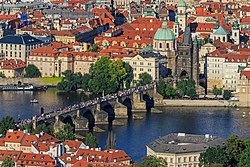
Welcome to Charles Bridge, the stone crossing over the Vltava River in the heart of Prague. It links the Old Town on one bank with the Lesser Town, in Czech Malá Strana, on the other, and it points you straight toward Prague Castle. Stand still for a moment and you will hear footsteps on the paving, street musicians, and the murmur of people from all over the world. This is Prague's oldest bridge, and it is one of the most photographed monuments anywhere. A fortified tower guards each end, and a procession of statues of saints lines both sides. Today it is a place for a stroll, but for centuries it was something much bigger: a vital artery of the city, a ceremonial road for kings, and a witness to floods, revolutions and rebuilding. Over the next few minutes we will look at how the bridge came to be, the stories carried by its statues, and how it has survived everything the river and history threw at it. Take your time, keep to the edge if you want to listen, and let the bridge unfold at its own pace.
Every great bridge begins with a problem, and here the problem was the river. Prague's earlier crossing, the Judith Bridge, was badly damaged by floods in 1342. Charles the Fourth, the king whose name the bridge carries today, commissioned a new stone bridge in 1357. Google even marked the 660th anniversary of the bridge with a doodle on the ninth of July, 2017. The bridge is built of sandstone blocks, and it is flanked at each end by fortified towers: the Lesser Town Bridge Towers on one side and the Old Town Bridge Tower on the other. Here is a surprise: for centuries it was not called Charles Bridge at all. It was simply the Stone Bridge or the Prague Bridge, and it only received its royal name in 1870. Its importance is hard to overstate. Until 1841 it was the only way to cross the Vltava here, which made it the key link between Prague Castle and the Old Town. That land connection helped make Prague a crossroads on the trade route between Eastern and Western Europe. It also lies on the historic coronation route of the Bohemian kings, so you are walking a path that once carried royal processions.
Look along the parapets and you will see the bridge's most famous feature: a continuous alley of 30 statues and statuaries. Most are baroque in style and were originally erected around 1700, though the carving of the whole series stretched from 1683 to 1928. The people they depict are saints and other Christian figures, from the Madonna to Jesus, and sculptors such as Jan Brokoff worked on them. The first statue to appear was a bronze figure of Saint John of Nepomuk, set up as a reminder of his being thrown from the bridge in 1683. It remains the most famous of them all. The original bronze is now kept in the Lapidarium of the National Museum in Prague. Here is something many visitors do not realize: the statues you are looking at now are all replicas. The originals were replaced to protect them. Another detail to find is the cross with Calvary. Its sandstone sculpture was created by Emanuel Max in 1861, and the older bronze cross dates from 1629. Prague's tourism authorities say the statues represent great personalities who, in some way, moved the world.
A bridge that has stood for centuries has a long list of close calls. In 1848, during the revolutionary days, the bridge escaped unharmed from a cannonade, though some of the statues were damaged. In 1866, pseudo-gothic gas lights were erected on the balustrade, later replaced by electric lighting. In the 1870s the first regular public transport line, an omnibus, rolled across it, later replaced by a horse tram. The bridge towers underwent a thorough reconstruction between 1874 and 1883. Then, from the second to the fifth of September 1890, another disastrous flood struck Prague and severely damaged the bridge. The statues have had their own dangers. On the third of November, 1918, a crowd destroyed the Marian Column in Old Town Square. According to accounts, it then intended to proceed to Charles Bridge and throw its statues into the river. A French sculptor, Antoine Bourdelle, visiting in the late nineteenth century, called the bridge an architectural mish-mash of Gothic and Baroque styles. Today the bridge is in the middle of a twenty-year process of structural inspection, restoration and repair that began in late 2019, with an expected cost of 45 to 60 million Czech crowns, roughly 1.9 to 2.6 million United States dollars.
Before you move on, try seeing the bridge in different lights. Prague's tourism authorities say its magic stands out especially at night, when the glow of the gas lamps seems to sculpt new stories into the stone. That is when Prague legends rise to the surface, with tales of statues leaving their pedestals to help people in need. Superstition also says there is a particular spot on the bridge that grants visitors their secret wishes. Whether or not you believe it, it is a lovely excuse to look closely at each statue as you pass. When you reach the far bank, consider wandering on to the Grand Priory's Mill or Lennon Wall, both close by. And if you turn back and look again at the towers, the saints and the river below, ask yourself what each generation of walkers has seen from this very spot. The bridge has plenty of stories left for you to find.
AI-generated from 6 sources; checked automatically and last updated on October 21, 2026. Verify tickets and opening hours on the official site.
This place is stop 2 of 3 of a self-guided walk: Old Town to Prague Castle. About 2.0 km and 25 minutes on foot, plus about 20 minutes of listening.
 Prague Old Town Walk
about 0.5 km · about 7 min on foot
Charles BridgeThis guide
about 1.5 km · about 20 min on foot
 Prague Castle at Hradcany
Live Walk Mode: 2 hours for 50 credits (€4.99 Starter pack)
Prague Old Town WalkPraguePrague Castle at HradcanyPrague Emmaus MonasteryPrague
 Frauenkirche DresdenDresden
 Burg KreuzensteinLeobendorf
 Burghausen CastleBurghausen
Plan your trip on a map and get an audio guide for almost any place nearby: just tap it on the Mappu map.
About 6 minutes of listening in 5 sections: “Welcome to Charles Bridge”, “A Crossing Born from a Flood”, “The Avenue of Saints”, “Survivor of Floods, Cannons and Crowds”, and “Before You Head Off”.
Every great bridge begins with a problem, and here the problem was the river. Prague's earlier crossing, the Judith Bridge, was badly damaged by floods in 1342. Charles the Fourth, the king whose name the bridge carries today, commissioned a new stone bridge in 1357. Google even marked the 660th anniversary of the bridge with a doodle on the ninth of July, 2017. The bridge is built of sandstone blocks, and it is flanked at each end by fortified towers: the Lesser Town Bridge Towers on one side and the Old Town Bridge Tower on the other.
You can ask follow-up questions such as “Why did Prague need a new stone bridge in the fourteenth century, and what made this crossing so important for trade?” and keep asking in Mappu, with the guide connected to your map and trip plan.