

Bruges City Hall: how long is the free audio guide?
About 6 minutes of listening in 5 sections: “Welcome to Bruges City Hall”, “From Jail to Gothic Showpiece”, “A Facade That Set the Fashion”, “Inside the Gothic Hall”, and “Before You Head Off”.
Six centuries of civic power on Burg Square

Quick answer. Yes. Mappu’s Bruges City Hall audio guide (Bruges, Belgium) is free in your browser: 5 sections and about 6 minutes of listening, in 6 languages. It covers “From Jail to Gothic Showpiece”, “A Facade That Set the Fashion” and “Inside the Gothic Hall”. In the Mappu app, Walk Mode narrates the places around you as you move and answers your follow-up questions.
Mappu's own map of the place, with the paths and entrances OpenStreetMap shows around it.
Welcome to Burg Square, the heart of Bruges, and to the building that has housed its government for more than 600 years: the City Hall, known locally as the Stadhuis. Look up at the facade for a moment. Tall windows, each framed by its own niche, rise in rhythm across the stone, and the whole front feels like a piece of carved lace. The square itself is a story too. Burg occupies the area of the former fortified castle at the center of the city, and it was once both the civil and the religious administrative center of Bruges. The City Hall was built between 1376 and 1421, which makes it one of the oldest city halls in the former Burgundian Netherlands. Over the next few stops we will look at why this building was built, what makes its design so influential, what waits inside the Gothic Hall, and how the empty niches on the facade became a debate that ran for centuries. Take your time on the square. The building is best enjoyed slowly.
Before this building stood here, the city council met in an older structure called the Ghyselhuus. It had once served as a jail for the Count of Flanders and had already fallen out of that use. After a fire in the city's Belfry in 1280, it was the Ghyselhuus where the council still gathered. In 1376 the old house was pulled down and a purpose-built council building took its place. Count Louis laid the foundation stone, and Jan Roegiers was given responsibility for the construction. The project was completed late in 1421, after roughly 45 years of work. The scale of the ambition tells you about the city at the time. The flamboyant opulence of the building reflects the economic and political power of Bruges, whose population is believed to have reached more than 37,000, and perhaps even 45,000 people. This was the earliest late-Gothic monumental council building in Flanders or Brabant, a bold statement in stone that a city of merchants and craftspeople governed itself from a home worthy of princes.
Now look closely at the stone facade of the oldest part. Windows are set inside repeating niches, systematically positioned, creating a strong vertical rhythm. Admirers call this the Brugian span, and it is a defining feature of Bruges Gothic civic architecture. Historians add a note of caution: it is not clear that this effect was invented in Bruges, but it is certainly displayed here to wonderful effect. What is clear is the influence. This pioneering stone facade inspired, in quick succession, the city halls of Brussels, Ghent, Leuven and Oudenaarde. In the sixteenth and seventeenth centuries the building was extended towards the south several times, so what you see is a family of additions around an original core. Then there are the niches themselves. Each one was designed to hold a statue beneath a decorative canopy, and for a long time many stood empty. The argument over how to fill those alcoves in Bruges lasted until 1989, when the city finally asked sculptors to reinstate the original statues of rulers and biblical figures. A debate that long deserves a good look up.
Inside, a huge staircase leads you up to the Gothic Hall on the first floor, and this is the room most visitors remember. Its polychrome vault is richly painted, and the hall took its present form around the turn of the twentieth century, between 1895 and 1905. Even the structure doubles as decoration: medallions in the keystones show prophets and saints, while corbels carry the seasons and elements of nature. Some original fourteenth-century consoles still support the vault. On the walls, murals by the artist Albrecht De Vriendt show scenes from the history of Bruges. Like the monumental mantelpieces, they are neo-Gothic enhancements, a later age's dream of the medieval past, painted with real affection for it. This is also a working room. Bruges City Council still holds its monthly meetings in the Gothic Hall, so the political life of the city continues beneath those painted vaults. Downstairs, life-size portraits of former rulers look back at you, mayors, kings, emperors and even Napoleon. Nearby, the adjacent Historic Hall presents the story of the city, with display cases holding the first coins used in Bruges, archive pieces such as the great seal, and a copy of the historical account by Galbert of Bruges. An exhibition on Bruges and the sea explores the lost Zwin ports that were central to the city's prosperity.
Before you leave Burg Square, try a small experiment. Stand back far enough to take in the whole facade and follow the rhythm of the niches from one end to the other. Then pick out one statue and imagine the long debate that finally filled those alcoves. Then think about the idea behind all of it. Anyone interested in the tension between citizens and their rulers will find that story running through this building, from the portraits downstairs to the murals above. A council that began meeting in a former jail of the Counts of Flanders ended up governing from one of the most admired civic buildings in the Low Countries. The square around you holds many more layers, from the old castle ground to the surrounding landmarks. Let your eyes wander, and see what else on Burg catches your imagination.
AI-generated from 6 sources; reviewed for accuracy and last updated on October 25, 2026. Verify tickets and opening hours on the official site.
This place is stop 3 of 3 of a self-guided walk: Bruges Christmas markets. About 0.7 km and 10 minutes on foot, plus about 18 minutes of listening.
Indicative route. While you walk, watch where you're going, mind the traffic and follow local signs and rules. The map is an aid, not a safety guide. Terms
 St. Salvator's Cathedral
about 0.5 km · about 7 min on foot
 Belfry of Bruges
about 0.2 km · about 3 min on foot

Bruges City HallThis guide
Walk Mode, in the free Mappu app: 2 hours for 50 credits (€4.99 Starter pack)
Belfry of BrugesBrugesSt. Salvator's CathedralBruges Saint-Andrew Abbey in ZevenkerkenBruges
 Gravensteen CastleGhent
 St Catherine's ChurchBrussels
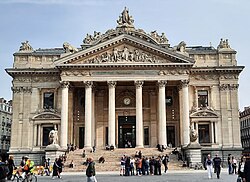 Brussels Stock ExchangeBrussels
Plan your trip on a map and get an audio guide for almost any place nearby: just tap it on the Mappu map.
About 6 minutes of listening in 5 sections: “Welcome to Bruges City Hall”, “From Jail to Gothic Showpiece”, “A Facade That Set the Fashion”, “Inside the Gothic Hall”, and “Before You Head Off”.
You can ask follow-up questions such as “What was the Ghyselhuus, and how did the city council end up meeting there before the new City Hall was built?” and keep asking in Mappu, with the guide connected to your map and trip plan.