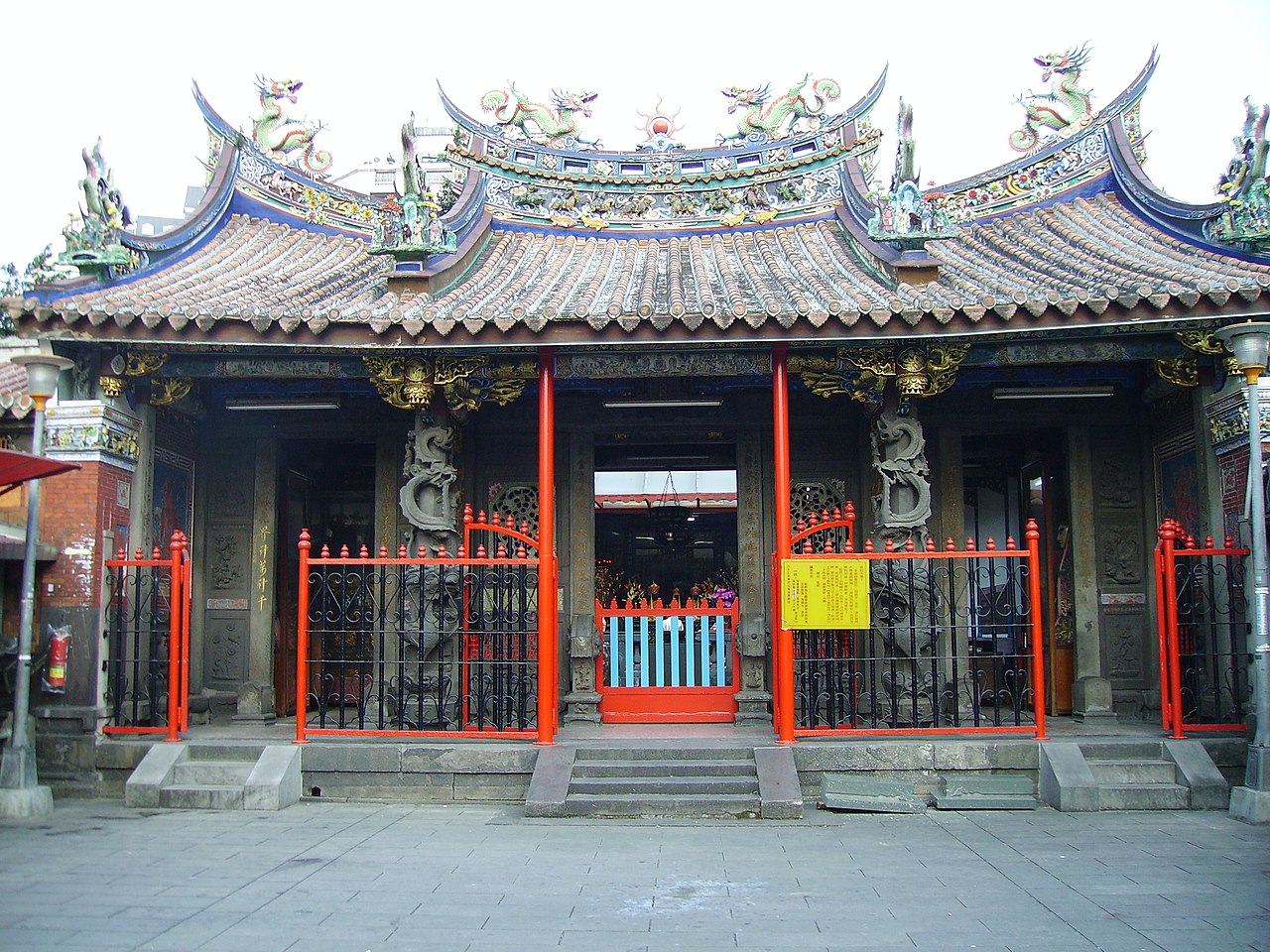
Now let's look at the building itself. The temple sits facing west, with its back to the east. Its plan is two halls, two connecting corridors and two flanking wings, all wrapped around an open courtyard. The main axis is three bays wide, and with the wings it forms the pattern builders call seven wrapping three. Covered passages link the wings to the main halls, and behind the wings you will find a two-story loft, a special feature of this temple. Behind the altar in the main hall there is also a walkway, a feature rarely seen in Taipei. At the middle door of the front hall stand a pair of sturdy dragon pillars. Look closely at the beams, the stone walls and the pillars, where you will find carved dates naming Qing dynasty reigns. The carving style is plain, thick and robust rather than delicate. For this reason the temple has been described as one of the most characteristic and artistically accomplished Taiwanese temples of the middle Qing period. The Taipei City Government has designated it a municipal historic site, recognizing its historical, cultural and artistic value. Its symmetrical wings and tidy layout are part of what makes it a standard example of traditional temple design. Beyond Qingshui Zushi, the temple also honors Mazu, Guan Yu, the Literary God Wenchang, Ksitigarbha, Confucius, Kuixing and the Earth God, so it is worth looking around the halls for the many deities.