


Coba Ruins: how long is the free audio guide?
About 7 minutes of listening in 5 sections: “Welcome to Coba”, “The Great White Roads”, “Nohoch Mul and the Great Ascent”, “The Prophecy of Deep Time”, and “Living with the Jungle”.
Unveiling the Lost Megacity of the Maya
Quick answer. Yes. Mappu’s Coba Ruins audio guide (Quintana Roo, Mexico) is free in your browser: 5 sections and about 7 minutes of listening, in 8 languages. It covers “The Great White Roads”, “Nohoch Mul and the Great Ascent” and “The Prophecy of Deep Time”. In the Mappu app, Walk Mode narrates the places around you as you move and answers your follow-up questions.
Last verified October 11, 2026. Sources: lugares.
Mappu's own map of the place, with the paths and entrances OpenStreetMap shows around it.
Welcome to Cobá, a place where the jungle still holds tight to its secrets. You are standing in what was once one of the most powerful and massive city states in the Mayan world. Unlike the manicured lawns of Chichén Itzá or the ocean views of Tulum, Cobá is raw, wild, and incredibly atmospheric. The name itself—Cobá—beautifully translates to 'waters stirred by the wind' or 'ruffled water,' a direct nod to the five surrounding lagoons that allowed this civilization to thrive in an otherwise dry landscape. Between the years six hundred and nine hundred after the common era, this site was a regional powerhouse, housing anywhere between fifty thousand and one hundred thousand people. As you look around, notice how the trees seem to be reclaiming the stone. Only a fraction of the estimated 6,000 structures here have been excavated, meaning that beneath those mounds of earth and vines you see, ancient palaces are still sleeping. Take a moment to breathe in the humid air—you are not just at a tourist site; you are deep inside a living historical mystery.
If you look beneath your feet, you are likely walking on or near a 'Sacbe,' which means 'white road' in Mayan. You are currently at the nexus of the largest network of stone causeways in the entire ancient Mayan world. These weren't just simple paths; they were incredible feats of engineering. The Maya raised these roads about one meter high, paved them with limestone dust, and finished them with white plaster so they would glow under the moonlight, effectively creating a 24 hour transit system. Specifically, Sacbé Number Four is part of this massive web that kept the city’s residential and ceremonial hubs connected. Some of these roads were 10 meters wide, and the longest one found here, Sacbé Number One, stretches an unbelievable 100 kilometers to the city of Yaxuná. These roads were the veins of the empire—used for trade, shifting armies, and grand religious processions. As you move through the site, consider renting a bicycle for about eighty Mexican pesos; it is the most authentic way to cover ground and truly appreciate the sheer scale of this ancient city.
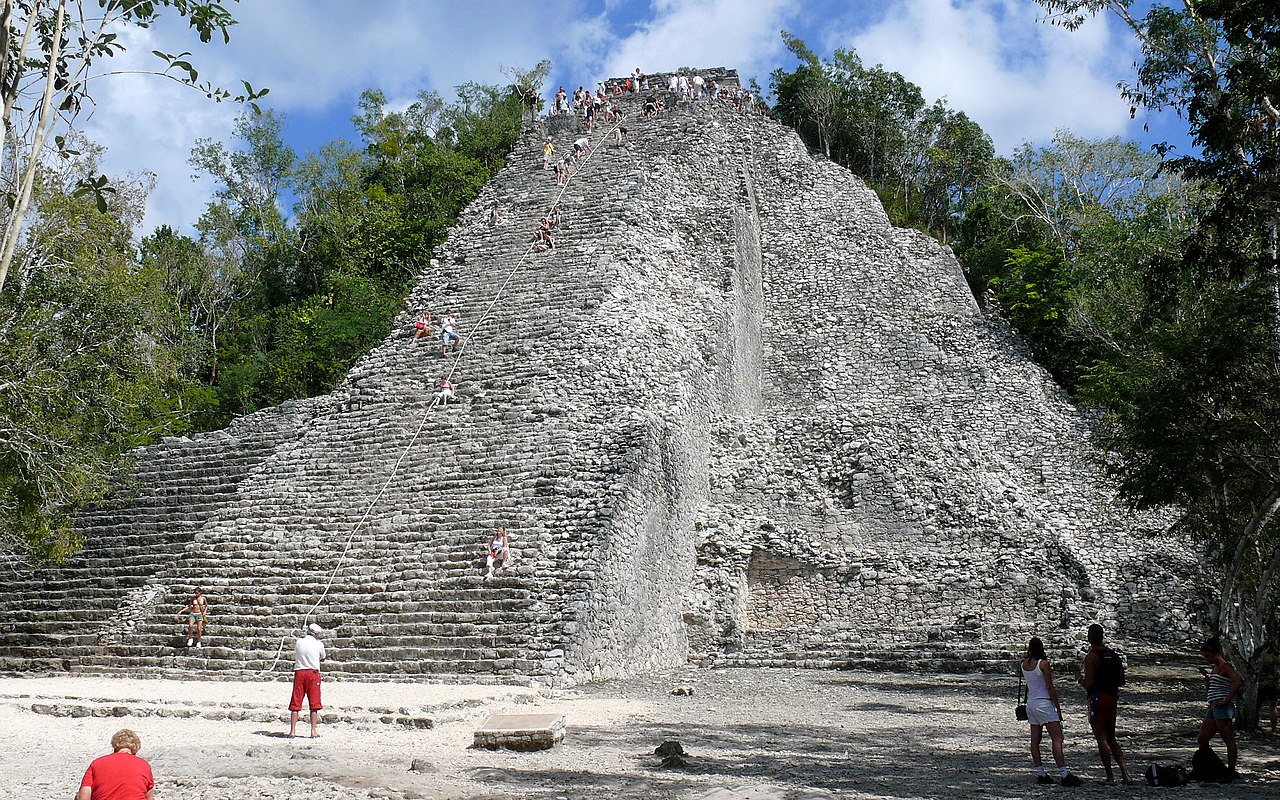
Rising 42 meters above the forest floor is the Nohoch Mul pyramid, one of the tallest structures in the entire Yucatán Peninsula. Its name literally means 'Great Mound,' but it served a much more divine purpose as a religious center and a symbol of royal power. For several years, the 120 original stone steps were closed to the public to prevent erosion, but there is some incredible news for your visit: as of December eighth, 2,025, the climb has officially reopened. To protect the monument, the authorities have installed a new wooden staircase system that sits directly over the ancient stones. This allows you to climb safely while preserving the site for future generations. Once you reach the summit—a climb organized in small groups—you will be rewarded with a view that is truly spiritual. In every direction, the green canopy of the jungle stretches to the horizon, broken only by the shimmering blue of the lagoons. It is the exact same view a Mayan priest would have had over 1,000 years ago.
As you explore, you will see many tall, thin stone slabs protected under thatched roofs. These are 'stelae,' the stone billboards of Mayan history. They record the lives of rulers, military victories, and complex dates. Cobá is home to one of the most famous inscriptions in modern culture: Stela Number One. This stone contains a series of calendar cycles that go back billions of years into what the Maya called 'deep time.' It was this very stone—and its mention of the end of a cycle that occurred on December twenty first, 2,012—that fueled the worldwide 'end of the world' craze. But here is the secret: to the Maya, this wasn't an apocalypse. It was just a giant cosmic odometer resetting to zero. They viewed time as a repeating circle, not a straight line to destruction. Standing here today is proof that the world did not end; rather, we joined a new era that the ancient Maya predicted over a millennium ago.
As you continue your walk through the Acrópolis, keep your eyes on the trees as much as the stones. This area is a vibrant ecosystem home to spider monkeys, butterflies, and exotic birds like the turquoise-browed motmot. You might hear the distant, guttural call of a howler monkey—a sound that has echoed through these ruins since they were first built. If you have any energy left after your trek, there are three stunning underground cenotes located just 6 kilometers from the entrance, which are perfect for cooling off after your jungle hike. Before you leave, remember that Cobá was eventually defeated by the forces of Chichén Itzá around the year 1000, yet people continued to live and worship here until the Spanish arrived in the 1500s. As you wander back toward the entrance, listen for the sounds of 'ruffled water' from the lake and imagine the bustling megacity that once hummed with life right where you stand now.
AI-generated from 9 sources; checked automatically and last updated on June 3, 2026. Verify tickets and opening hours on the official site. Independent guide by Mappu. Not affiliated with or endorsed by the site or its managers.
Planning a trip to Quintana Roo?
Mappu sketches your days free in the chat, no account needed. Then take the full plan with you:
Already going? The 2-hour live walk in Quintana Roo is €4.99
Tickets, tours and practical extras for this trip, from Mappu's partners.
Partner links (Airalo, Amazon, Booking.com, GetYourGuide, Klook, Tiqets, Trip.com, Viator, Welcome Pickups): if you book or buy through them, Mappu may earn a commission, at no extra cost to you.
 Quiriguá Los Amates
 Zona Arqueológica de Yagul Tlacolula
 Zona Arqueológica de Dainzú San Jerónimo Tlacochahuaya
 Monte Albán Oaxaca
Plan your trip on a map and get an audio guide for almost any place nearby: just tap it on the Mappu map.
About 7 minutes of listening in 5 sections: “Welcome to Coba”, “The Great White Roads”, “Nohoch Mul and the Great Ascent”, “The Prophecy of Deep Time”, and “Living with the Jungle”.
You can ask follow-up questions such as “What exactly were the 'White Roads' or Sacbeob used for in Mayan daily life?” and keep asking in Mappu, with the guide connected to your map and trip plan.