


Basilica of Santa Croce: how long is the free audio guide?
About 7 minutes of listening in 5 sections: “Welcome to the Heart of Florence”, “The Temple of Great Minds”, “A Revolution in Art”, “Resilience and the Mud Angels”, and “Beyond the Nave”.
Quick answer. Yes. Mappu’s Basilica of Santa Croce audio guide (Florence, Italy) is free in your browser: 5 sections and about 7 minutes of listening, in 8 languages. It covers “The Temple of Great Minds”, “A Revolution in Art” and “Resilience and the Mud Angels”. In the Mappu app, Walk Mode narrates the places around you as you move and answers your follow-up questions.
Last verified October 11, 2026. Sources: santacroceopera.
Mappu's own map of the place, with the paths and entrances OpenStreetMap shows around it.
Welcome to the Basilica of Santa Croce, the largest Franciscan church in the world. As you stand here in the vast Piazza Santa Croce, you are looking at the Pantheon of Italian Glories, a title given to this sacred space because it serves as the final resting place for some of the greatest minds in history. Legend says the original small oratory on this site was founded by Saint Francis of Assisi himself around the year 1210. However, the magnificent Gothic structure you see today was begun in 1294, likely designed by the architect Arnolfo di Cambio, the same master who worked on the Florence Cathedral and the Palazzo Vecchio. As you enter, notice how the building feels like a massive, quiet sanctuary separated from the bustling city outside. It is designed in the shape of an Egyptian cross, or a capital T, a symbol deeply connected to the Franciscan order.
As you walk through the nave, you are walking among giants. To your right, you will find the tomb of Michelangelo Buonarroti, the master of the Renaissance, designed by Giorgio Vasari. Look closely at the three weeping figures on his monument; they represent Painting, Sculpture, and Architecture, mourning their lost master. Further along, you will encounter the resting place of Galileo Galilei. Interestingly, Galileo was not allowed a proper burial here for nearly 95 years after his death because of his conflict with the Church over his scientific theories. Eventually, his remains were moved here to face Michelangelo, symbolically bridging the gap between art and science. You will also find monuments to the political philosopher Niccolò Machiavelli and the composer Gioachino Rossini. Each tomb is not just a grave, but a monument designed to inspire you with the potential of human genius and civic pride.
Step toward the front of the church to explore the chapels flanking the high altar, particularly the Bardi and Peruzzi chapels. These spaces were commissioned by wealthy banking families of the fourteenth century. Inside, you will see frescoes by Giotto, the man often called the father of Western painting. Look at how Giotto broke away from the flat, gold-backed style of the Middle Ages to show real human emotion and space. In the Bardi chapel, he tells the story of Saint Francis with a sense of drama that was revolutionary for its time. These paintings were actually covered with whitewash in the eighteenth century and only rediscovered in the mid-nineteenth century, a reminder of how tastes in art change over hundreds of years. Be sure to also find Donatello’s Annunciation, a masterpiece in gilded limestone that shows two figures with a tender, lifelike realism that still feels modern today.
Near the sacristy, you will encounter a symbol of tragedy and hope: Cimabue’s Crucifix. On November fourth, 1966, a devastating flood hit Florence when the Arno River broke its banks. The water inside this basilica reached a depth of nearly 6 meters in some spots, leaving behind thick mud and heating oil. Cimabue’s thirteenth-century masterpiece was submerged and lost 70 percent of its original paint. It became the symbol of the catastrophe, but also of the international effort to save Florence's heritage. Hundreds of young volunteers, known as the Angels of the Mud, rushed from all over the world to clean the paintings and monuments by hand. As a practical pointer, if you look at the walls throughout the complex, you can still see small markers showing the high-water line from that day. Please remember that Santa Croce is a place of worship; out of respect, you should ensure your shoulders and legs are covered while exploring.
Before you move on, take a moment to step into the peaceful cloisters outside the main church. Here, you will find the Pazzi Chapel, an architectural gem by Filippo Brunelleschi, who also designed the famous dome of the Florence Cathedral. Its simple, proportional gray and white surfaces represent the perfection of early Renaissance design. As you finally leave through the main doors, take a last look at the colorful nineteenth-century facade. It was designed by a Jewish architect named Niccolò Matas. Look at the very top of the central gable, and you might spot a large Star of David—a bold and unique inclusion on a Catholic basilica that reflects the diverse history of the people who shaped Florence. There is always more to find in these quiet corners—perhaps a hidden family crest or a forgotten inscription that invites you to wonder about the thousands of stories tucked away in this stone treasure chest.
AI-generated from 2 sources; checked automatically and last updated on June 3, 2026. Verify tickets and opening hours on the official site. Independent guide by Mappu. Not affiliated with or endorsed by the site or its managers.
This place is stop 1 of 3 of a self-guided walk: Santa Croce to Sant’Apollonia, Florence. About 2.1 km and 30 minutes on foot, plus about 19 minutes of listening.
Indicative route. While you walk, watch where you're going, mind the traffic and follow local signs and rules. The map is an aid, not a safety guide. Terms

Basilica of Santa CroceThis guide
about 1.7 km · about 23 min on foot
 Chiostro dello Scalzo
about 0.4 km · about 5 min on foot
 Cenacolo Di Sant'Apollonia
Walk Mode, in the free Mappu app: 2 hours for 50 credits (€4.99 Starter pack)
Planning a trip to Florence?
Mappu sketches your days free in the chat, no account needed. Then take the full plan with you:
Tickets, tours and practical extras for this trip, from Mappu's partners.
Partner links (Airalo, Amazon, Booking.com, GetYourGuide, Klook, Tiqets, Trip.com, Viator, Welcome Pickups): if you book or buy through them, Mappu may earn a commission, at no extra cost to you.
 Palazzo Vecchio Florence
 Florence Duomo Florence
 Ponte Vecchio Florence
 Galleria dell'Accademia Florence
 The Soul of the Oltrarno Florence
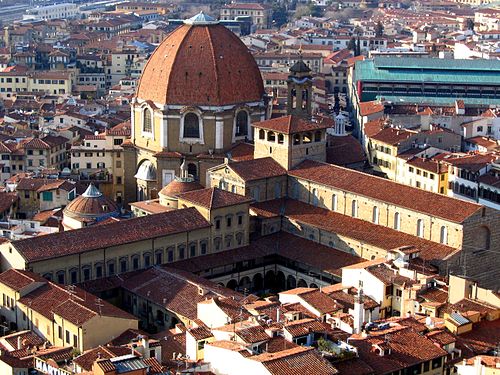 Medici Chapels Florence
 Basilica of San Domenico Siena
 Saint Mark's Basilica Venice
 Saint Peter's Basilica Rome
 Chiesa Nuova Rome
Plan your trip on a map and get an audio guide for almost any place nearby: just tap it on the Mappu map.
About 7 minutes of listening in 5 sections: “Welcome to the Heart of Florence”, “The Temple of Great Minds”, “A Revolution in Art”, “Resilience and the Mud Angels”, and “Beyond the Nave”.
You can ask follow-up questions such as “Why is the Basilica often called the 'Pantheon of Italian Glories'?” and keep asking in Mappu, with the guide connected to your map and trip plan.