Upper Belvedere Audio Guide

Prince Eugene's palace of display, painted halls and a famous signature

Upper Belvedere
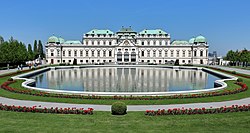
Photo by C.Stadler/Bwag / Wikimedia Commons / CC BY-SA 4.0 · Wikimedia Commons · CC BY-SA 4.0

6 min of listening · Section 1 of 5: Welcome to Oberes Belvedere

Prefer reading? The full guide is below

Keep exploring

Discover more places in Mappu, or start Walk Mode when you’re there.

Live Walk Mode: 2 hours for 50 credits (€4.99 Starter pack)
Upper Belvedere • Section 1 of 5

Upper Belvedere: is there a free audio guide?

Quick answer. Yes. Mappu’s Upper Belvedere audio guide (Vienna, Austria) is free in your browser: 5 sections and about 6 minutes of listening, in 6 languages. It covers “A Prince, a Summer Residence and a Palace for Show”, “Hildebrandt's Architecture and the Gardens Below” and “Painted Ceilings, a Gallery and a Treaty”. In the Mappu app, Walk Mode narrates the places around you as you move and answers your follow-up questions.

Upper Belvedere: what does the audio guide cover?

  1. 01

    Welcome to Oberes Belvedere

    Welcome to the Upper Belvedere, the palace that crowns the higher ground of one of the great Baroque ensembles in the world. You are just south of the Ring, on the edge of central Vienna. The name comes from Italian and means beautiful view, and as you stand here, you will understand why. The Upper Belvedere is one half of a pair. Together with the Lower Belvedere and the long gardens that tie them together, it forms a single complex that Prince Eugene of Savoy, successful general and passionate art connoisseur, had built as his summer residence by the architect Johann Lukas von Hildebrandt. In his day this spot still lay outside the gates of the city. Over the next few stops we will look at how this palace was meant to impress, at the painted rooms inside, and at the day in 1955 when it became the stage for a moment in Austrian history. Take a breath, look up at the façade, and let us begin.

  2. 02

    A Prince, a Summer Residence and a Palace for Show

    Prince Eugene of Savoy lived from 1663 to 1736. He was a celebrated general, and he left a lasting mark not only on politics but also on the art and cultural history of Austria. Before the Belvedere, he had already had a city palace built from 1697 in the Himmelpfortgasse, within the walled city, by Johann Bernhard Fischer von Erlach. The Belvedere was something different: a garden palace in the open country. The two palaces had different jobs. The Lower Belvedere, completed in 1716, was where the prince actually lived. The Upper Belvedere, built in the early 1720s, was all about representation: a place to receive, to impress and to show what a man of his standing could create. Its name is simple. It is the Upper one because it sits on higher ground. The prince was also a famous patron and an avid collector, with a taste for sixteenth and seventeenth century Italian, Dutch and Flemish art. Keep that in mind as you look at the building, because it was designed to be seen, admired and talked about.

  3. 03

    Hildebrandt's Architecture and the Gardens Below

    Johann Lukas von Hildebrandt gave the Upper Belvedere its famous silhouette. Its highlights inside are the grand staircase, the Marble Hall and the garden hall on the ground floor, known as the Sala terrena. An architectural historian has pointed out that, because of many later changes, the palace today looks like decorative scenery meant to be admired from a distance. Hildebrandt's original idea, reconstructed from old views and engravings, was more complex. A set of architectural views by Salomon Kleiner, made between 1731 and 1740, records how the ensemble looked in its early days. Now turn toward the gardens, because the palace was never meant to stand alone. A reflecting pool in front of it catches the façade, so the building appears twice. Large terraces with ponds link the Upper to the Lower Belvedere, and the garden includes a shell fountain, a cascade fountain and a pond. One part, the Kammergarten, was originally reserved for the master of the house and his closest associates. Walk the slope between the two palaces and you are following a design in which architecture, water and landscape work as one.

  4. 04

    Painted Ceilings, a Gallery and a Treaty

    Step inside, and the palace becomes a painted world. On the ground floor, the Sala terrena has walls that are fully painted, with a ceiling picture called Apollo and Aurora, showing the victory of light over darkness. It is by Carlo Carlone, with the architectural painting by Gaetano Fanti. Fanti was also chosen by Prince Eugene for the illusionist architectural painting in the Marble Hall, and the Neapolitan master Francesco Solimena was commissioned to paint an altarpiece in the palace chapel and the ceiling in the Gold Cabinet. The building's role changed over time. From 1776 to 1891, the imperial picture gallery had its home here. And on 15 May 1955, in the Marble Hall of the Upper Belvedere, the Austrian State Treaty was signed. Since 1955 the palace has also been the seat of the Austrian Gallery Belvedere. Today the rooms present Austrian art from the Middle Ages to the present, in a sequence that runs from medieval and Renaissance works through the Baroque, Classicism and Biedermeier, into Vienna around 1900 and the modern avant-gardes. Around 400 works tell 800 years of art history.

  5. 05

    Before You Head Off

    As you leave, turn around once more and look at the façade from the garden side. Notice how the reflecting pool doubles it, and how the building seems to grow out of the slope. This is exactly the effect that Prince Eugene's palace was designed to create. If you still have curiosity left, there is plenty to follow. Look at how the painted ceilings play with architecture, so that you cannot tell where the real stonework ends and the illusion begins. Follow the terraces down toward the Lower Belvedere and think about the difference between a palace made for display and one made for living. And if you are walking with younger travelers, the park has an augmented reality game in which you look for the animals that already lived here in Prince Eugene's lifetime. The Belvedere rewards a slow walk. Every angle seems to offer a new view, which is precisely what its name promises.

About this guide

AI-generated from 6 sources; reviewed for accuracy and last updated on October 23, 2026. Verify tickets and opening hours on the official site.

Run a travel site or blog? Embed this audio guide for free.

Walk on from here

This place is stop 4 of 4 of a self-guided walk: Hofburg to the Belvedere, Vienna. About 2.8 km and 40 minutes on foot, plus about 26 minutes of listening.

Route map: walking on from Upper Belvedere4 numbered stops in walking order. Stop 1: Hofburg Palace; Stop 2: Vienna State Opera; Stop 3: Karlskirche; Stop 4: Upper Belvedere.
Distances are estimates along the walking route, from OpenStreetMap.
  1. Hofburg Palace

    about 0.6 km · about 7 min on foot

  2. Vienna State Opera

    about 0.9 km · about 12 min on foot

  3. Karlskirche

    about 1.4 km · about 18 min on foot

  4. Upper BelvedereThis guide

Photo attribution

Live Walk Mode: 2 hours for 50 credits (€4.99 Starter pack)

See the whole walk

Useful for your visit

Tickets, tours and practical extras for this trip, from Mappu's partners.

Partner links (Airalo, Amazon, Booking.com, GetYourGuide, Klook, Tiqets, Trip.com, Viator, Welcome Pickups): if you book or buy through them, Mappu may earn a commission, at no extra cost to you.

Plan your trip on a map and get an audio guide for almost any place nearby: just tap it on the Mappu map.

Common questions

Upper Belvedere: how long is the free audio guide?

About 6 minutes of listening in 5 sections: “Welcome to Oberes Belvedere”, “A Prince, a Summer Residence and a Palace for Show”, “Hildebrandt's Architecture and the Gardens Below”, “Painted Ceilings, a Gallery and a Treaty”, and “Before You Head Off”.

What is the story behind the Upper Belvedere?

Prince Eugene of Savoy lived from 1663 to 1736. He was a celebrated general, and he left a lasting mark not only on politics but also on the art and cultural history of Austria. Before the Belvedere, he had already had a city palace built from 1697 in the Himmelpfortgasse, within the walled city, by Johann Bernhard Fischer von Erlach. The Belvedere was something different: a garden palace in the open country.

Upper Belvedere: what can I ask Mappu after the guide?

You can ask follow-up questions such as “What was the difference between the roles of the Upper Belvedere and the Lower Belvedere in Prince Eugene's time?” and keep asking in Mappu, with the guide connected to your map and trip plan.